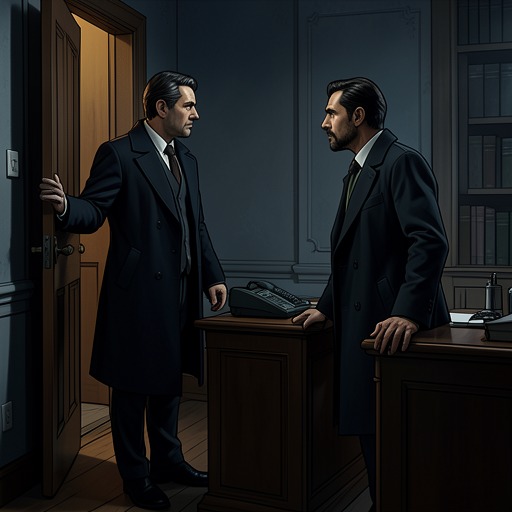
Haller and Bosch use a newspaper story to draw out Vincent’s killer
The Brass VerdictMickey Haller and Harry Bosch’s newspaper trap is an investigative plan to draw out the person who killed Jerry Vincent by making a potentially dangerous loose end visible to that person. Haller agrees to the risk after Bosch proposes an exclusive for the Los Angeles Times; the ensuing story portrays Haller as ready for Walter Elliot’s trial and reports that he recovered Vincent’s case strategy from a backup flash drive.## Background and stakesThe plan takes shape over dinner at Dan Tana’s, where Haller has ordered a steak and initially takes time over his meal. Bosch asks for help with the killing of Jerry Vincent, and Haller answers that their purpose will be to draw out the killer. Bosch does not minimize the danger: the scheme depends on shaking things up and making the unknown person think that a loose end remains, perhaps one that could pose a threat. The uncertainty is part of the proposal, not a risk Bosch claims to have eliminated. Haller asks how dangerous it will be and whether Bosch will be present; Bosch says he will be there every step of the way. The promise offers partnership and protection, but it does not make the operation safe. Vincent’s killing has already left Haller carrying the work and cases of a murdered colleague, while the person responsible remains at large. A plan that deliberately attracts that person’s attention therefore puts Haller’s public profile to investigative use.## Designing the newspaper lureBosch’s proposed instrument is a newspaper story rather than a direct approach to a suspect. He expects reporters to be calling Haller and suggests choosing one, granting an exclusive, and planting something in the article that will affect the killer’s understanding of the case. The intended effect is psychological: the killer should be led to think that the situation is not settled and that someone may still be able to expose or endanger them. The story is thus meant to communicate on two levels. To ordinary readers it is a report about the impending trial; to the killer, the planted material is meant to suggest that a loose end persists. The available account does not specify a separate message, a response from the killer, or the eventual result of the lure. Haller has already promised a reporter at the Los Angeles Times that he would speak when he was ready. That prior arrangement gives the plan a practical route into print, while also raising a concern about how fairly to deal with the press. Haller remembers Lorna Taylor’s warning about playing fair with the media. The trap therefore requires more than choosing information that might attract the killer: it also places Haller’s existing dealings with a reporter inside a strategy designed to manipulate what a reader infers.## Haller’s decisionBosch’s assurance that Haller will be covered does not remove Haller’s hesitation. As the discussion turns to how the plan would be carried out, Haller thinks about his daughter, Hayley Haller, and the questions she may one day ask—the same questions her mother asks. He recalls the sting of her look and the difficulty of explaining that his work can seem like service to the wrong side, even when the truth is more complicated. This thought interrupts the dinner more decisively than the discussion of physical danger: Haller puts down his utensils without eating and finds that he is no longer hungry. He then accepts the plan. His agreement follows not from an assurance that the danger is negligible, but from weighing the work against its personal cost and choosing to proceed. The scene makes the newspaper scheme an ethical as well as an investigative decision. Haller must knowingly invite attention from a killer while continuing to inhabit the role of defense attorney, a role that his daughter may find difficult to distinguish from helping the guilty. The meal’s interruption marks the point at which the proposal stops being hypothetical and becomes a commitment.## The story in printThe subsequent Los Angeles Times article gives the operation a public-facing form. Headlined as a report on the attorney taking over for his murdered colleague and on the coming trial, it is by Jack McEvoy, a Times staff writer. It describes Haller stepping into Vincent’s shoes two weeks earlier, with 31 inherited cases and the especially high-stakes defense of Walter Elliot, the 54-year-old chairman of Archway Studios. Elliot is charged with murdering his wife and her alleged lover six months earlier in Malibu, and testimony is scheduled to begin on the day of publication. The article also recalls that Vincent, aged 45, was found shot to death in his car in downtown Los Angeles. It places Haller’s new role beside the unresolved killing that gives the trap its purpose, without identifying the killer or reporting that the publicity has drawn a response. A concrete account of the missing materials makes the story more than a general announcement of Haller’s readiness. Vincent’s briefcase had been stolen from his car and contained his laptop and calendar. Haller says rebuilding the calendar was manageable, but the laptop had been the central storage point for case information and strategy; the hard files left in the office were incomplete. He had initially thought the loss left the defense unable to proceed. The article then discloses what the thief had missed: Vincent backed up his computer on a digital flash drive attached to his key chain. Haller went through megabytes of data and recovered pieces of strategy for the Elliot trial. Jury selection had taken place the previous week, and Haller said he would be fully prepared when testimony began. The story’s report of that recovery supplies a specific demonstration of Haller’s preparedness. It is consistent with Bosch’s broader plan to put information before the killer, though the evidence does not identify which detail, if any, was deliberately planted as the bait.## Significance and limitsThe operation turns journalism into an investigative instrument: Haller’s access to a reporter becomes a means of influencing what Vincent’s killer believes, while the article remains a public account of a major defense case. Its most pointed contrast is between the stolen laptop, an apparent loss that threatened to cripple Haller’s preparation, and the overlooked flash drive that restored crucial pieces of Vincent’s strategy. That reversal makes the story’s declaration of readiness credible, but also makes Haller’s recovery of the material visible to anyone reading it. The arrangement depends on the killer noticing the report and interpreting its contents as evidence of an unresolved danger. Haller accepts that exposure despite his reservations about dealing fairly with the media and the personal unease stirred by his daughter’s questions. Bosch’s assurance that he will remain present is part of the bargain; no outcome is established here. The event’s significance lies in converting Haller’s inherited casework and restored information into a possible lure, while leaving the actual response—and the danger of provoking it—open.